Texas brewers’ legal victory significant for more than obvious reasons

Texas State Capitol

mask-of-silenus-avatarThis week, Texas craft brewers claimed something rare for their industry in this state. They won a legal victory.

The drama began three years ago with what was then known as Senate Bill 639. Introduced into the 2013 state legislative session by Dallas state senator John Carona (who subsequently lost the next election), the bill stated its intent of “protecting the independence of distributors” by eliminating compensation for craft breweries for territorial distribution rights of their products. Essentially, it stripped small breweries of the right to make money by selling their brand—something the distributors still had the privilege of doing once a distribution agreement was signed.

Craft brewing has the same rights of identity as any other industry operating in this state.

In an unprecedented action, three Texas craft breweries took the state legal code to task in December 2014. Two North Texas breweries, Peticolas Brewing of Dallas and Revolver Brewing of Granbury, jointly filed suit with Austin’s Live Oak Brewing and the Institute for Justice against the Texas Alcoholic Beverage Commission (TABC) to have the new law overturned as a violation of the state constitution. For small businesses like today’s craft breweries, the ability to make money selling their distribution rights can be a big revenue source at start-up, not to mention that they would receive no benefit or compensation should a contracted distributor strike a later deal. It was a blatant and vulgar power-grab by the wholesalers lobby, and challenging it was the right thing to do.

District Court Judge Karin Crump agreed this week, finding no compelling state interest in such a law. Although consumers may not see any tangible benefit from such an esoteric lawsuit, it will only contribute to the improving health and strength of craft brewing in Texas (which ultimately benefits consumers). However, more has been achieved with this decision than simply rolling back biased regulations or defending the pockets of small brewers. This decision may be a truly significant turning point for the brewing industry in Texas.

First significant legal challenge in Texas craft brewing

The craft brewing industry has made monumental advances in Texas brewing laws in recent years, probably the largest favorable gains since legalization of brewpubs back in 1993. They have struggled tirelessly to change laws both state and municipal; they have fought zoning, distributors, retailers, even conservative anti-alcohol groups who have no interest in craft beer. They face down the TABC and lobbyist groups every two years when the legislature meets in Austin.

What makes this result any different? This was a legal challenge to an existing law enacted in 2013, not a state-wide popular movement for incremental change. This was not grass-roots anything: these were some of the most knowledgeable, seasoned professional brewers this state has to offer taking on an unjust law forced upon their industry by a much more powerful special-interest group.

And the judge agreed with them. This giant is not as invincible as we once thought.

Intellectual property matters, even for breweries

What also sets this struggle apart are the stakes over which it is being fought. Of course, every legal matter regarding business and regulation can usually be boiled down to money and, truthfully, this decision is no different. Laws are enacted to win economic power and either project it or protect it. The parties behind laws are always fighting to control bigger pieces of their respective pies.

However, this lawsuit was not explicitly about commerce or access or territory or financial advantage over a competitor. The lawsuit just won was brought over control of a brewery’s intellectual property, the ownership of their fundamental rights as a business at the point of distribution and thereafter in future transactions. Too long has craft brewing been singled out as an industry, operating under a legal double-standard not even shared with wine and other alcohol manufacturers. Craft brewing has the same rights of identity as any other industry operating in this state.

Craft brewers can collaborate on more than just beer

Collaborations are nothing new for the craft beer game. If not simply a business partnership for a combined venture, genuine friendships develop and result in new and inventive beers. Brewery X will meet Brewery Y at a common event like the Great American Beer Festival and decide to collaborate on a flashy, co-branded product. The industry is embarrassingly amicable to direct competitors, even those in the same market, and these ventures usually result in a win-win-win for both parties and consumers.

But this collaboration is a brand-new animal. Texas craft breweries have now demonstrated that they can band together not only for a united front for change before lawmakers; they can also work together to fight for a focused, tactical purpose on behalf of their entire industry. Craft brewing is no longer a domain of hobbyist businessmen selling in a boutique marketplace. This was a grown-up lawsuit, and we walked away with the W. SD
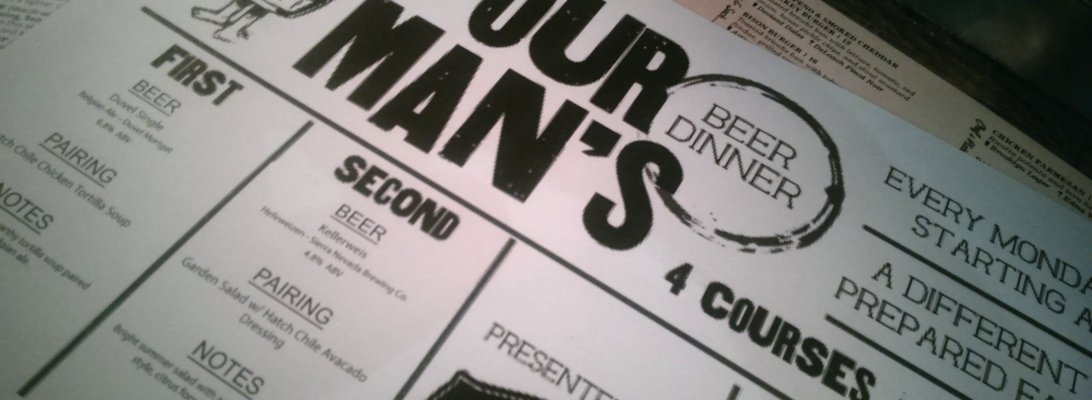
Common Table Poor Man’s Beer Dinner still on point

Poor Man's Beer Dinner

Dallas Craft Beer Examiner

Common TableToday, beer and wine dinners have become almost a yawning marketing commodity among the bar and restaurant industry. But in the days a half-decade ago when craft beer was just establishing its foothold in North Texas, beer-pairing dinners were rare and celebrated events.

Early movers with Dallas beer dinners both in prominence of brewing figures they attracted as well as the outstanding craveability of the food and beer pairings were Meddlesome Moth and The Common Table, two of the more senior and respected local craft beer meccas. Whereas the Moth still hosts preeminent dinners of no decline in quality, The Common Table left the standard event model years ago for a still-novel concept: the weekly Poor Man’s Beer Dinner. Prepared afresh each time, an affordable multicourse meal is paired with stocked commercial craft beers but offered regularly and to order.

Recently realizing that a couple of years had passed since my last Poor Man’s dinner, their past Monday offering caught my eye with the theme of Hatch chiles, that seasonal consumer darling that overruns Central Market and seems to spawn marketing gold each summer. Often these dinners are constructed around a theme, usually by breweries newly arrived to Texas with their products, but being a fan of the fruit (yes, chiles are a fruit) I had to give this one a try. I’m happy to report that the quality of this meal deal remains top-notch.

First course
Hatch chile chicken tortilla soup paired with Duvel Single
Hatch chile chicken tortilla soup

A small bowl of chunky soup with thin, fried tortilla strips, the dish was deliciously flavored but burning with fiery chile heat. Although somewhat a chore to finish (at least for my bolillo heat tolerance), it was the hottest element of the entire meal, and woke up the palate with a full-faced alarm.

The paired course beer, Duvel Single, is Moortgat’s lighter version of their Belgian pale ale, single-fermented for the same flavors but without the strength of regular Duvel. One would think it an optimal match for the Hatch heat but alcohol does little to quench capsaicin once it makes camp on your palate.

Second course
Garden salad with Hatch chile avocado dressing paired with Sierra Nevada Kellerweis

Garden salad with Hatch chile avocado dressing

Seemingly plain in comparison, this simple mixed greens salad had a smooth, lightly creamy dressing with a pleasant cooling effect after the heat of the previous course. The flavor of the Hatch was captured and eased somewhat by the smooth, fatty avocado texture.

Sierra Nevada Kellerweis is that brewery’s unfiltered wheat ale brewed after a traditional Bavarian style. It worked with the fresh salad to tame the heat of the previous course as well as the flavors themselves pleasantly complimenting each other.

Third course
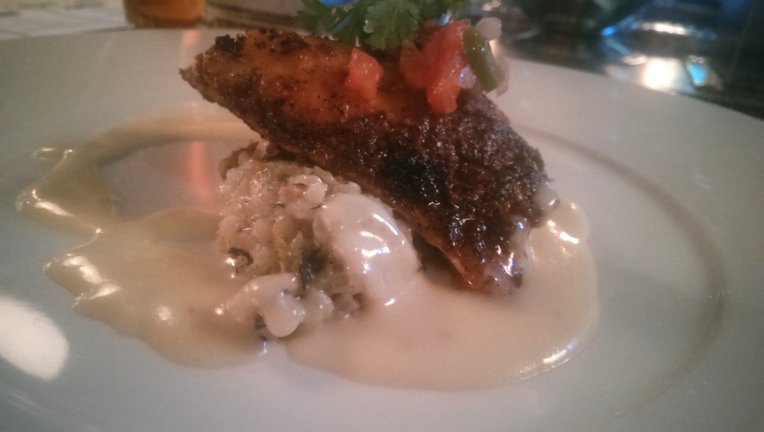
Blackened red snapper with Hatch chile risotto fortified with Fontina served on a lemon beurre blanc paired with Community Mosaic

Blackened red snapper with Hatch chile risotto (fontina) and a lemon burre blanc

This dish was outrageously perfect, and by far the star of the evening. Perfectly cooked snapper was served mildly blackened with mellow cajun spices to work with but not overshadow the still-lingering pepper heat. It was dressed with a tart lemony sauce and served on a bed of luscious Hatch chile risotto beautifully fortified with Fontina that almost overshadowed the entrée. (I would enjoy this added as a regular menu item, or at least a rotating special.)

Paired with Community Mosaic, the aggressive IPA brought enough sharp flavors for a fresh, palate-cleansing bite. On its own, Mosaic is one of my personal weekly go-to beers and easily one of the top IPAs to come out of North Texas.

Fourth course
Vanilla bean ice cream with candied Hatch chiles and crushed pecans paired with Samuel Smith’s Oatmeal Stout

Vanilla bean ice cream with candied Hatch chiles and crushed pecans

One would never think of chiles as a dessert item but candied, sliced rounds of Hatch chiles still coated in sugar provided a fantastic vegetal flavor to the creamy scoop and crunchy pecan bed. All elements for the entire dish just synched, both in flavor and texture.

The last stocked bottle of Sam Smith was served just before my course was served, but calling an audible with Ninkasi Vanilla Oatis worked equally as well. With all respect to Tadcaster ( a legend on its own), Ninkasi’s oatmeal stout with vanilla was an even better match for this particular course.

Unknown at the start, this was Chef Nick Wells’ last Poor Man’s dinner as he leaves this week for a new kitchen not too far away (Dots Hop House, a new Deep Ellum venture soon to open from the owners of Denton’s Oak Street Drafthouse). Once again, The Common Table proves it has an expert hand in not only selecting a quality lineup of taps but also a kitchen still strongly firing on all cylinders.

Walk in any Monday evening between 6:30 and 9pm for a small treat of refined yet affordable cuisine. SD

COOP Ale Works brings The Big Friendly to Texas

COOP The Big Friendly's Trail to Texas

Dallas Craft Beer Examiner

COOP Ale Works

Texas is the center of the beer universe — well, our universe, at least for those of us who live here. Texans acknowledge that our adjoining sister states have breweries but we rarely give any thought to the more mainstream beer operations just over our state borders. (We also don’t acknowledge Colorado as a genuinely separate state and still claim it as “Far North Texas,” but that’s another discussion.)

Louisiana’s Abita Brewing enjoys the most notoriety from Texas consumers by virtue of wide distribution but, although just a few hundred miles distant, offerings from Arkansas, Oklahoma and New Mexico rarely get our attention or any significant tap space. Tulsa’s Prairie Artisan Ales has probably had the most success recently with some of their more original farmhouse products, but we living under the Lone Star know more about Oklahoma’s infamous “3.2 laws” than about any of their breweries.

COOP The Big Friendly’s Trail to Texas
Style: Berlinerweisse with peaches
Rating: 3/5

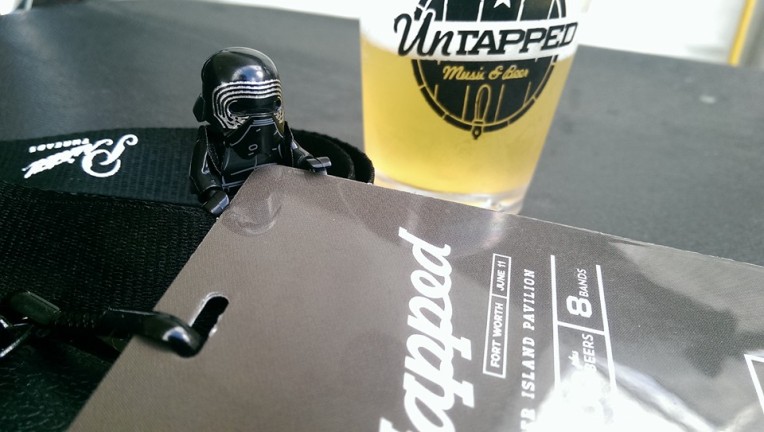
That is about to change as COOP Ale Works of Oklahoma City recently rolled into North Texas with planned events all over the Metroplex leading up to a prominent spot at Fort Worth’s Untapped Fest last week. They brought with them The Big Friendly, a modified school bus that is now a pub-on-wheels and rolling ambassador for the brand, parking at several Dallas and Fort Worth locations as they served beer samples and introduced the company to Texans.

COOP Ale Works began in 2009, part of the same fast-evolving craft beer movement taking place here and around the country. They went through a major facilities upgrade in 2014 that has allowed them to begin expanding into neighboring states, with North Texas their first market south of the Red River. Now one of the largest breweries operating in Oklahoma, their estimated output of 15,000 barrels this year puts them just behind Rahr & Sons Brewing in size and capacity. (Unrelated but at the same time, Rahr & Sons has just begun distribution out of state to Oklahoma.)

In celebration of their arrival, COOP brings with them a special release named The Big Friendly’s Trail to Texas, a peach-infused berlinerweisse style limited to only 3000 bottles. It is a kettle- soured beer, meaning a touch of Lactobacillus was added to the wort ahead of the yeast to begin developing some desired sour elements before primary fermentation, and then 10 bushels of fresh peaches were blended in for the finished corked-and-caged product.

Trail to Texas is a mild 4% ABV that pours a hazy light gold with a thin head that disappears too quickly and a very light sour nose with apparent but indistinct fruit, maybe mild citrus or melon. The flavor profile is very much a classic berlinerweisse, a light and refreshing wheat flavor with a touch of tartness. A faint peach element does emerge in the back of the swallow, subtle, just enough to let you know it’s there. I would have preferred a little more carbonation to give it more life on the palate but such is the nature sometimes with bottle conditioning.

Of course, COOP arrives in DFW with a half dozen or so of the more popular beers in their portfolio, including beers such as Alpha Hive, a double IPA with orange blossom honey, and several special twists on their standard DNR Belgian dark ale. With North Texas now COOP’s largest market outside of their home state, make sure they notice how thirsty Texans can be.

Availability: Trail to Texas may be difficult to find with such limited quantities, but COOP beers should now begin to appear on shelves and taps throughout North Texas.

Cheers!


Originally published June 21, 2016, at Examiner.com. 

Big Texas Beer Fest at five years

BTBF-2016_logoHow long does it take a craft beer festival to mature? Do they grow and evolve on the same life-line as bars, pubs or microbreweries? Do they lead (or lag) the local consumer economy?
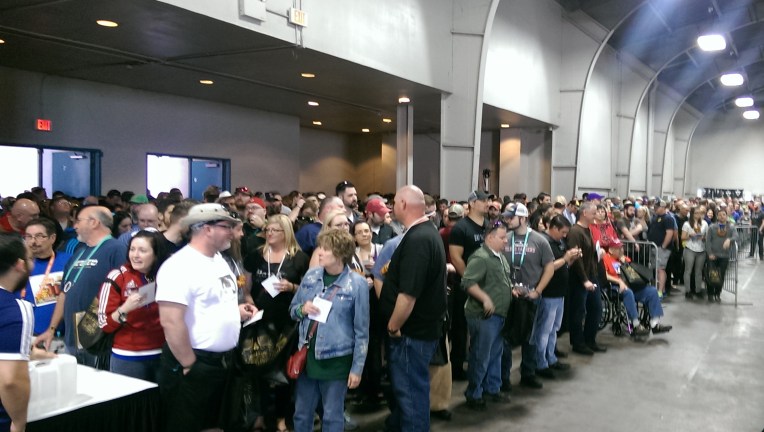
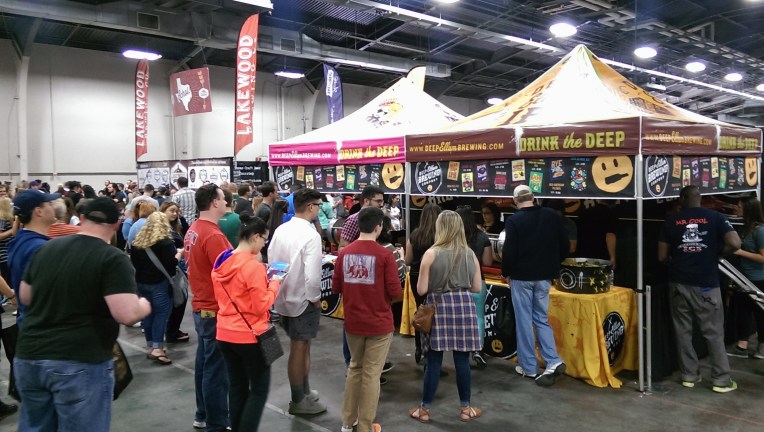
Last weekend, Dallas saw the fifth annual iteration of the Big Texas Beer Fest. It filled the cavernous Automobile Building at Fair Park as it has from the start with the spring weather cruelly perfect for a mostly indoor festival. Thousands of thirsty craft beer fans pressed into the fairgrounds Friday evening and all day Saturday, the decision made to wisely spread attendance over two sessions instead of packing more ticket holders into the same square footage.

BTBF-2016_2

I wandered through the wide aisles early, getting my beer bearings and warming up my palate with just a sip of Goose Island‘s Bourbon County Rare, sweet and syrupy with a deep flavor reminiscent of a classic Thomas Hardy. The growling crowd of VIPs pushed at the nylon ropes, awaiting their one hour jump on entry before general admission, and that Golden Hour can be just enough time to find some of the rare and special brews hidden among the booths that will inevitably disappear quickly. It also provides a more manageable, almost convivial experience among somewhat familiar and like-minded fans before the bulk of attendees crush in, even allowing room for a skateboarding Michael Peticolas.

In just five brief years, enthusiasts and absolute amateur fest promoters Chad and Nellie Montgomery have created what is now a Dallas craft beer institution. The Big Texas Beer Fest has become not only the largest single craft beer event in North Texas but also somewhat of a sure-bet experience, as it always concludes without significant faults or troubles and manages to provide an enjoyable experience to all attendees, from beer novice to professional drinker.

BTBF-2016_3

Certainly, there have been growing pains from the inception of this festival but nothing catastrophic. Ticketing and entry procedures were a big delay that first year but understandable for trying to move crowds measuring close to 5000 individuals. The air conditioning was overlooked one year and left the venue too warm, but with this particular venue and time of year that was a decision simply made too late. Water stations, ice, layout, food vendors and logistics have all been incrementally improved year after year to the benefit of attendees and representatives alike.

Small things we thought would be major headaches turned out to be nothing at all. –Nellie

This year, brewers and related vendors stretched to each end of the facility with the soundstage and bands moved to their own fenced and adjoining space outside. Early years of this festival placed them inside at the endspace of the building, dominating the limited indoor acoustics, but outside they thrive with a captive crowd surrounded by grilled aromas from circled food trucks. With the first truly great weekend weather of the year, the postcard blue sky seemed to attract as many fest-goers as did the beers inside.

BTBF-2016_4

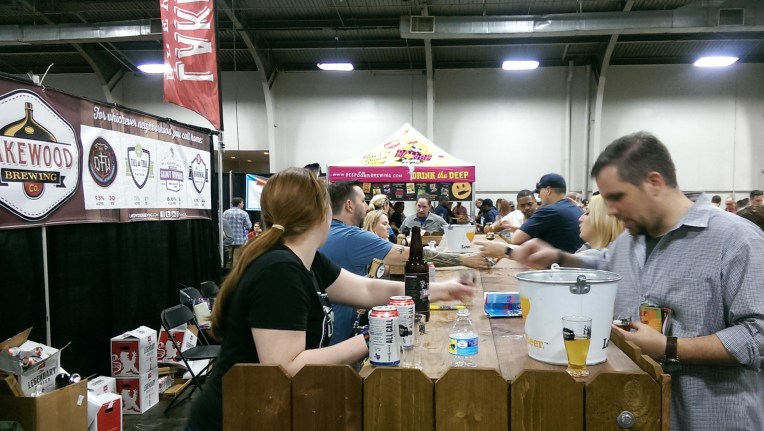
Inside saw the participation of about 150 craft breweries this year, heavy on the in-state brewers and even more so for those local to North Texas. The high-traffic DFW favorites such as Deep Ellum, Peticolas, Community and Rahr & Sons anchored the larger locations at the end of the aisles, providing more access for their surging interest and demand. Lakewood used its space and this opportunity to debut their new All Call cans, a clean, lightly malted and refreshing kölsch brewed in association with the firefighters and police support organization Guns & Hoses, and which will undoubtedly become a popular best-seller. Major national microbrands were also represented, if not with a featured booth of their own then a smaller presence manned by distributors and volunteers.

Two o’clock brought the general admission ticket holders, and the comfortable crowd of VIPs surged into a sea of people, from the ordinary to the weird. Brewery tee-shirts, pretzel necklaces, beards, funny hats and even the occasional cosplay blended among the ordinary fans, casual and daily consumers now immersed in craft beer culture for a few hours. Longer lines formed for popular breweries, and sought-after specialties were greedily drained.

BTBF-2016_5

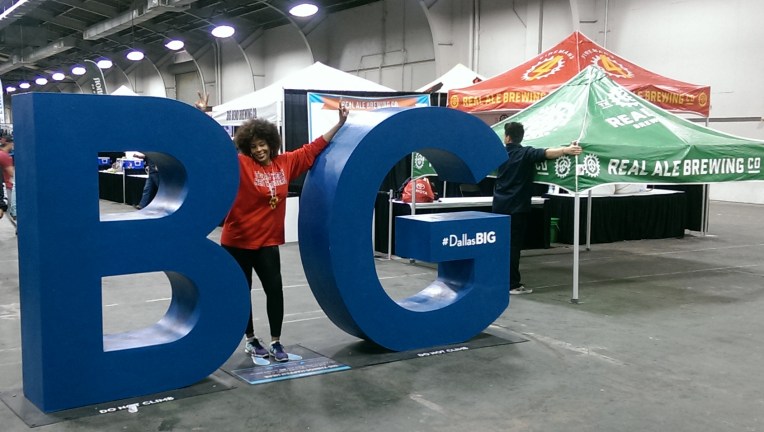
Instead of stocked tables uniformly staffed with reps pushing samples, many breweries embraced the evolving festival spirit by loosening their corporate collars. Shannon Brewing set up a small pub in their space, complete with video games. Franconia brought what has become their signature ice sculpture taps, chilling the beer with embedded tubing. Martin House hosted a small disk golf competition out of their booth adjacent to the obligatory blue “B” and “G” photo-troll display from the Dallas Convention and Visitors Bureau.

…even allowing room for a skateboarding Michael Peticolas.

Crowds continued to grow both inside and out in those hours after late arrival. The sea of people thickened into a dense mass on the inner aisles, with traffic snaking around queues and oblivious conversation pods and Untappd users logging beers on their phones. The buildup always peaks somewhere around the four o’clock hour, the drinking balance reached of early attendees and the spent just beginning to depart. Traditional for beer fests, a dropped sampling glass (historically glass but now plastic, for obvious reasons) elicits a roar from the crowd that propagates down the length of the building like a stadium wave. The collective effects of alcohol begin to show, mildly.

BTBF-2016_6

A wide variety of beers were to be found, not only wide of style and flavor but across the spectrum of quality as well. The best are obvious, as any craft beer list online can gladly recount, and the worst are discretely dumped into a nearby wash bucket. But the fun is more in the unexpected: those great beers flying under the radar, relationships revealed, gems rarely hyped or newly discovered. Bitter Sisters debuted their Winter Bush, a refreshingly plain but solid Russian imperial stout, dark and roasty without bitterness, barrel aging or liquor enhancements, wholly un-messed with. Artisanal brewer Jolly Pumpkin, known for their delicate bottle-conditioned farmhouse ales, also brews great traditional American styles under the North Peak Brewing label. And On Rotation made a very unique and tasty Jalapeño Saison infused with cucumber — it’s weird, but it works.

BTBF-2016_1

It was also a nice touch to include local brewpubs such as Dallas’ native Humperdinks, brewers from the local California-chain Gordon Biersch locations in Dallas and Plano, and even Irving’s Twin Peaks breastaurant (now brewing on-site), talented brewers all but of a status and caliber often overlooked or dismissed at fests such as these. Disappointly, the acclaimed Asian bistro-brewer Malai Kitchen was expected but absent, no doubt victim to a spring weekend overstuffed with competing and conflicting food-themed events around the Metroplex.

I managed to talk with Nellie briefly during the event, and asked about the most important thing she and Chad learned with now five years of craft beer festival planning under their belt. “Don’t sweat the small stuff,” she said. “Small things we thought would be major headaches turned out to be nothing at all.” SD

North Texas brewers need to step up their stout game

Dallas

Dallas Craft Beer Examiner

Today is November 5th, recognized as International Stout Day. Celebrate with a fresh craft stout from one of our local North Texas breweries, a refreshing beer such as… um…

Crickets chirping. That’s what you find when you go looking for a good, sessionable DFW stout. And as robust as our current craft beer scene is, that’s a downright shame.

Looking at local shelves and tap handles, it may appear that locally made stouts are plentiful. True, there are some prime examples out there of Russian imperial stouts, oatmeal stouts, sweet stouts, coffee stouts, barrel-aged stouts, and even stouts infused with chocolate, honey, vanilla beans, mint or raspberries. But if you look closer, these all skew strongly toward the heavy end of both the flavor and gravity spectrum, all clocking in at 8% ABV or much, much higher.

There is absolutely nothing wrong with these hefty, delicious stouts except that they are, well, pretty strong both in alcoholic kick and weighty calorie-laden, palate-crushing tastes. In their rush to the highest ground, North Texas craft brewers seem to have overlooked the other end of the stout spectrum that consists of richly flavored yet pleasingly drinkable stouts such as the dry (Irish) stout and its slightly hoppier cousin, the American stout.

The best-known example of the dry stout is Guinness, the archetypal Irish stout produced by a corporate giant that has near universal market saturation with a modest 4.2% ABV. For an American stout, you will have to reach out to breweries to our south (the seasonal Saint Arnold Winter Stout, 5.6%) or to beers brought in from out of state like Sierra Nevada Stout (5.8%) or North Coast Old No. 38 Stout (5.4%).

The Dallas/Fort Worth area just does not produce anything comparable. The closest we have in this category would be a couple of foreign export stouts, a slightly stronger style originally brewed for dedicated sales outside the country of origin such as Mother’s Little Fracker from Revolver Brewing (7.5%) or Braindead’s Export Stout (6.6%). Shannon Brewing makes a fine Chocolate Stout (5.7%) and Cobra Brewing has an award- winning “brownie stout” named Best Mistake (6.5%), both with ample cocoa natures. Martin House has There Will Be Stout (6.5%), a unique stout brewed with crushed sourdough pretzels that imparts a good salty quality. FireWheel’s Midnight Ninja started out close (6.5%) but has since drifted up to 8% ABV, and even that will not be around any longer as FireWheel Brewing announced they would close later this month.

North Texas craft brewers have shown they are not afraid to take on any beer style, even the rare, obscure and historical. We have available to us black ales, black lagers, dark IPAs and even black saisons, and we have plenty of all shades of porter. Brewers seem to embrace the low-end, hoppy session beers but few have tackled just a plain, enjoyable stout.

Here is a gap in the present market that one of our fresh, new breweries should grab as soon as they can. If I’ve overlooked any local sessionable stouts, please send me a note so I can go drink a lot of it.

Cheers!


Originally published November 5, 2015, at Examiner.com. 

What happened to the price of my beer?

Dallas

Dallas Craft Beer Examiner

Anno Domini 2014, that’s what happened. The new year brought with it some new tax laws, so bear with us as we attempt an explanation. I promise to make this as painless as possible, which means a minimum of math for you.

To begin, some basics of the industry. First, bars, pubs and restaurants operate under two different types of licenses in Texas with two different tax rates. There are places that serve only beer and wine (no liquor) with one license, and others that serve a full bar with beer, wine and mixed drinks under another license.

Second, these two different licenses have two different tax rates for on-premise sales. Beer-and- wine-only licensed sales are subject to state/local sales tax (currently 8.25%) but mixed beverage permits were not. Full-bar licenses had a separate excise tax of 14% on all alcoholic beverages — beer, wine and liquor — reported simply as a combined “gross receipts” of sales in their accounting. (This is an important detail.)

Third, taxes required by the state are usually built into the pricing of the beverage. (Ever wonder why drink prices are often whole dollar amounts?) This is the retailer adding in the tax to their own costs and rounding off pricing for ease of the transaction. You, the consumer, never saw this amount itemized on a tab but it has always been there.

Now for the 2014 changes: In an effort to increase transparency and equity in taxation, mixed beverage licenses are now subject to state/local sales tax as well with the excise tax being reduced from 14% to 6.7%. This new calculation yields about the same level of taxation as before (6.7 + 8.25 = 14.95%) and now you will see that sales tax appear itemized on your final bill going forward.

All this accounting really is the concern of the retailer but this is where the changes start appearing for you, the consumer. The retailer is required to pay the new taxes as described here but has the option of how to adjust their own pricing in response. Some places will continue to subsume the taxes in the final customer prices to maintain sales. Most are simply passing along the new sales tax directly to the consumer on the final bill, using last year’s final beverage prices. This is why your $5, 2013 pint of beer is now a $5.41 pint in 2014.

Note this change is only to the mixed beverage license, and includes all sales. Even beer or wine purchased at a full bar will be subject to the new rate (remember, “gross receipts”), which is a little inequitable for beer consumers but just part of doing business with the tax man. Beer/wine-only establishments should not see pricing changes — however, a few have now added explicit sales tax on the bill for reasons yet unclear.

Barely a week into the new year and new tax model, pricing is still in flux everywhere as retailers work to grasp the complicated details of the changes and adjust their prices verses costs accordingly. I would expect craft beer prices to float and shift for a month or two as owners and managers sort things out.

(Of course, I’m neither a tax officer nor an accountant, so anyone with authority or clarifications please step in and correct me where necessary.)

Cheers!


Originally published January 10, 2014, at Examiner.com